

My Lost-Faux Turner
by Victoria Spindler
Maybe what I was looking at was a Lost Turner, not a Faux Turner.
A picturesque 800-year-old listing in the Yorkshire Dales, Grassington should’ve piqued my interest early on. Cobbled streets, a 12th-century church, a 13th-century manor house, thought to be the oldest house in Yorkshire, somehow did nothing to enhance its allure. Not even the Dickensian Festival or Christmas Markets, or the 1940s Weekend, where everyone steps back in time, were able to ignite my enthusiasm to see the place everyone told me I needed to see.
“My mother is a New Yorker. They talk to anyone and everyone.”
Ironically, it was my mother who ultimately compelled me to visit Grassington. Arriving from New York on her 80th birthday, she informed me that she was staying a month and demanded to see all Yorkshire had to offer – the castles, abbeys, and everything in between. Which included my neighbours, most of whom I’d never met, seated at my kitchen table, hands in my cookie jar, chattering away with my mother like they’d known each other all their lives. A familiar scene, I don’t know how she does it. Except I do.
My mother is a New Yorker. They talk to anyone and everyone. They amass friends while riding the subways or standing in line at the deli. They bond over bagels and knishes; they argue politics and baseball with total strangers. Conversant in Russian, Yiddish, Italian, German, Chinese and Spanglish, as well as a dozen more obscure dialects most people have never heard of, New Yorkers are the friendliest, most hospitable people you’d ever want to meet.
“Who are all these people?” my husband demanded to know one evening as he came barreling through the back door and encountered a kitchen bearing an eerie resemblance to Grand Central Station.
“Dunno,” I replied nonchalantly, putting down the Yorkshire Post and taking a long look around. “They’re my mother’s new friends.” New friends, all of whom were insisting I take her to Grassington.
“Absolutely not!” I replied, telling my mother it was akin to going to the Hamptons in the summer. Shi-shi, populated with the beautiful people, the rich and the famous. Expensive.
“You don’t know that”, my mother countered, telling me I needed to grow up and ditch my attitude.
Two days later, I huddled beneath a shared umbrella with my mother as we navigated the quaint cobbled streets of Grassington. A stormy, dismal day, the kind of weather that keeps the hordes away, we had this ancient village to ourselves. I kicked myself for not having come sooner.
Galleries and boutiques, pubs, and cafes; footpaths leading to ancient windswept moors with dry stone walls and hay barns, becks and pony treks.
The glorious Yorkshire Dales, I vowed then and there to come back. In the meantime, my mother and I continued to amble about God’s Own Country, how Yorkshiremen rightfully refer to their splendid corner of the world. We trekked across the Howardian Hills; we walked around the castle at Helmsley. We sat in the market square beneath the watchful eye and statue of William Duncombe, the 2nd Earl of Feversham, wolfing down cheese and onion pasties from the local baker.
As much as we wanted to, we were finding it challenging to be tourists every day. Laundry needs to be done, groceries need to be bought. Depositing my mother in front of M&S in Pontefract one morning, I went to park the car, only to return to find her gone. Sprinting up and down the aisles, I called out to the checkout girls and asked if they’d seen my mom.
“You recognise it, of course,” my mother whispered into my ear. “It’s where I peed.”
As the sole American shopper, I was known to all, as was my mother, who they informed me they hadn’t seen. Returning to the Market Square, I’d been trying to guess where my mother might have gone when suddenly I heard her call my name.
“I’ve just seen the most amazing painting,” she yelled from the alley behind the Buttercross, beckoning me to come.
“What painting? I thought you were doing our shopping.”
“Oh, that. I thought it would be more interesting to go to the art show.”
“What art show?” I asked, struggling to keep pace with my mother, who, like most New Yorkers, is a marathon walker.
“The Pontefract Art Show,” she informed me, sprinting off in her non-sensible shoes, leaving me to follow. The Pontefract Art Show, held on the second floor of the Pontefract Museum, was what one might expect: the local art club showcasing the works of its members.
It was also not what I expected. It was good. All local scenery, all instantly recognisable. The tree that sat at the end of the lane across from the RDA horses in Ackworth, the farmhouse in the middle of Darrington. Bolton Abbey.
And then I came to it.
The painting.
“You recognise it, of course,” my mother whispered into my ear. “It’s where I peed.”
It was right after our lunch in Grassington, when we had barely gone two miles down the road, that my mother announced she needed to use the bathroom and told me to pull over to the side of the road.
With no woods for cover, I opened the doors of the car and stood guard, while she squatted in between. In the pouring rain, staring at the scenery in front of me, trying hard to ignore the goings on behind me.
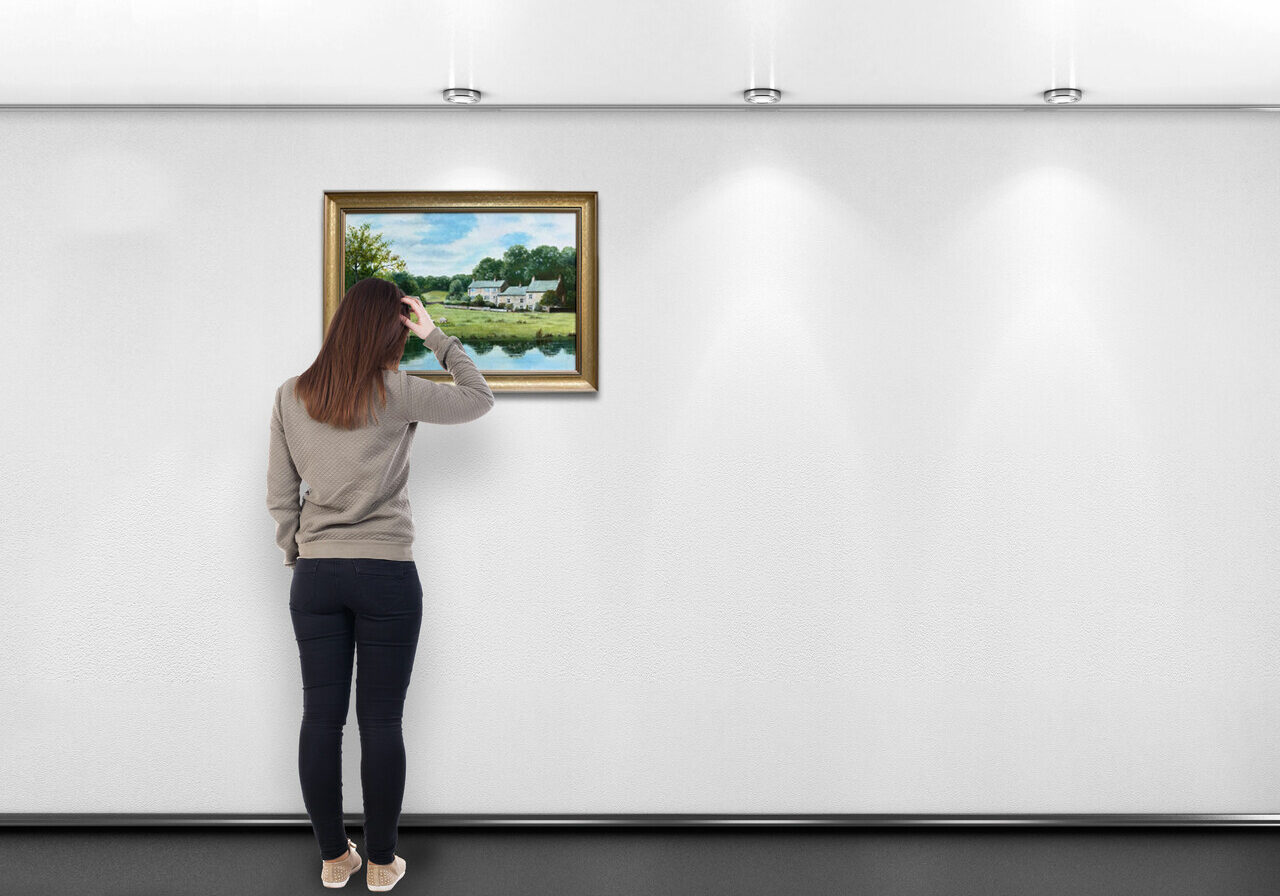
And now here I was, staring at the same scenery all over again. The gently rolling hillside, the lush verdant fields, the low stonewall, the cluster of three whitewashed cottages with a few soggy sheep ambling about.
“We have to buy it,” my mother declared, and I wholeheartedly agreed. He must have seen us lingering before his chef d’oeuvre, because it wasn’t long before we were joined by l’artiste.
“Done just outside of Grassington,” he informed us, as we told him we were familiar with the spot. “Sat right where Turner sat,” he continued, “painted the very same picture, though I reckon his is a wee bit better, what with him being world famous and all. The Pontefract Art Show’s not quite the likes of The Royal Academy, you know.”
I turned and looked at Keith, with whom we were now on a first-name basis because, naturally, my mother, the New Yorker, would have it no other way, and asked the question—the question with the potential to brand me a cultural ignoramus.
“Turner, who?”
“Joseph Mallord William Turner,” Keith replied, seemingly hurt I hadn’t recognised his long-dead mentor’s name. The famous and illustrious J.M.W. Turner, whose work he was striving to emulate.
“Oh, that Turner,” I replied, my mind now racing through the catalogues of his art.
In 1797, J.M.W. Turner befriended Edward Lascelles, a wealthy bonvivant and prominent fixture on the London social scene who considered himself to be a patron of the arts. It was at Lascelles’ behest that Turner first travelled to Yorkshire and Harewood House, where he’d been commissioned to paint the newly acquired ancestral home his father, the First Earl of Lascelles, had inherited two years earlier.
The journey to Harewood House took two months, not because it was a long and arduous expedition, but because Turner chose a somewhat circuitous route, an excursion calling for a sweeping tour of the North. Boarding a stagecoach in London, Turner took with him two very valuable items, items which today reside at the Tate Gallery in London: two leather-bound sketchbooks, the illustrated diaries of Turner’s travels in the North, which quickly became some of my most coveted guides to Yorkshire.
I’d been lost in thought when I felt it, my mother slapping my hand, something she’s done all my life whenever she sees me twisting my hair.
In the throes of indecision, I wondered if I should tell Keith his painting was a fake, that this was not a landscape Turner ever painted. Having spent the last two years crisscrossing Yorkshire, following in Turner’s footsteps, standing where he once stood while he sketched and painted this magnificent land, I’d bet my bottom dollar on it.
Then again, maybe I was wrong. Maybe what I was looking at was a Lost Turner, not a Faux Turner.
Deciding to hedge my bet, I turned to Keith and told him J.M.W. would be proud, whereupon tears welled up in his eyes.
“Thank you,” he whispered softly, clearly touched by the compliment, as I tucked my Lost-Faux Turner under my arms and have displayed it prominently ever since.
To share your memories email memories@northernlifemedia.co.uk or go to northernlifemagazine.co.uk/contribute
NorthernLife Sep/Oct/Nov 25