


How Cross-Chain Bridges Act as a Gateway to Bitcoin DeFi
by Northern Life
Learn how cross-chain bridges provide access to Bitcoin DeFi.
Bitcoin has long been seen as a store of value rather than a dynamic asset for decentralized finance (DeFi). However, with the rise of cross-chain bridges, bitcoin holders can now seamlessly participate in DeFi ecosystems across multiple blockchains.
These blockchain bridges unlock liquidity and expand Bitcoin’s utility beyond simple transactions and as a store of value.
Read on to learn how cross-chain bridges provide access to Bitcoin DeFi.
What Are Cross-Chain Bridges & How Do They Work?
Cross-chain bridges are specialised applications that enable the transfer of cryptocurrency or data between two or more distinct blockchain networks that normally cannot communicate with one another natively.
This interoperability solves a key limitation of blockchain technology, where each chain operates independently with its own rules, standards, and consensus mechanisms, making asset transfers across chains impossible without a bridge.
The fundamental mechanism of a cross-chain bridge typically involves locking an asset on the source chain and then minting an equivalent representation of that asset on the destination chain.
Cross-chain bridges connect these networks, allowing capital to flow freely
When the asset needs to return to its original chain, the minted asset on the destination chain is burned, and the original asset on the source chain is unlocked. This process ensures that the total supply of the asset remains consistent across all chains, preventing inflation or double-spending.
Bridges can vary in their design, from centralised solutions that rely on trusted intermediaries to more decentralised and trustless protocols that use smart contracts and cryptographic proofs.
This cross-chain functionality is crucial for the growth of decentralised finance (DeFi), as it enables assets like Bitcoin, which operates on its own blockchain, to participate in DeFi applications on other networks, such as Ethereum or Binance Smart Chain, unlocking new possibilities for lending, borrowing, and yield generation.
Why Does Bitcoin Need Cross-Chain Bridges?
Bitcoin’s security and liquidity are unmatched, yet its base layer was designed for stability and not for the flexibility demanded by modern DeFi.
Over recent years, thousands of DeFi applications have emerged on networks such as Ethereum and various Layer 2s. Without bridges, Bitcoin remains locked out of this innovation.
Cross-chain bridges connect these networks, allowing capital to flow freely and ushering in a new era of decentralised finance where bitcoin is no longer a passive asset but an active participant.
An Example of a Cross-Chain Bitcoin Bridge
Now, let’s look at an example of a cross-chain bridge that allows you to transfer assets from Bitcoin to another chain (and back).
Starknet’s StarGate Bridge
Starknet is a permissionless Layer 2 ZK-Rollup that significantly boosts Ethereum’s scalability, while also developing into an execution layer for Bitcoin.
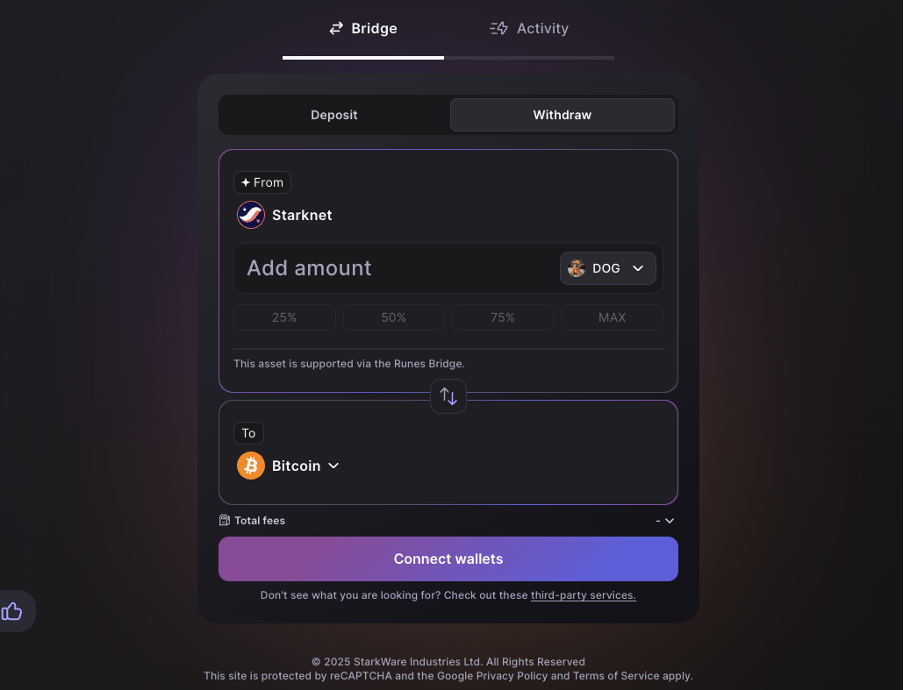
Starknet’s StarGate bridge has recently introduced Bitcoin bridging to Starknet, allowing users to transfer tokens between Bitcoin and Starknet.
Final Thoughts
The rise of cross-chain bridges, such as Starknet’s StarGate, is unlocking Bitcoin’s potential in DeFi by enabling BTC to move between different blockchain ecosystems. Now, anyone holding BTC can deploy their coins to earn yield in DeFi markets on different chains.