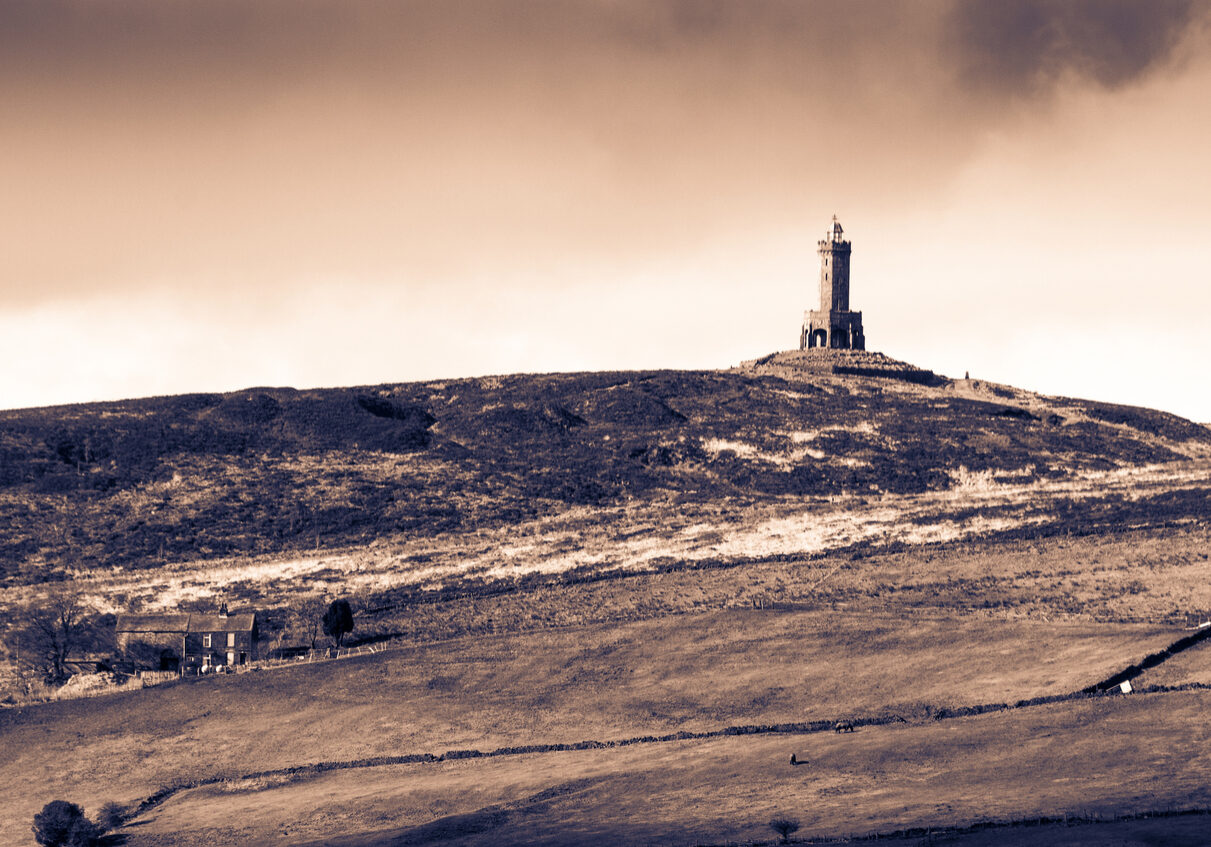

Far-Flung Prospects Over Darwen – Darwen Tower
by Graham Dugdale
Graham Dugdale admires a much-loved monument
As a young sprout of tender years, I often went to Morecambe with my parents on Sundays for an outing. Those were the days before the advent of the motorway. The route by way of Belmont across the moors was the most interesting. And every time, I was fascinated by the huge monument perched on the edge of Darwen Moor to the east. Boasting the distinctively finned caste of a sleek spacecraft, it always evoked colourful images of a daring Flash Gordon blasting off in search of the rascally Ming the Merciless.
And every time we passed, it was still there, hovering. Spare parts problem perhaps? Who knows? That said, numerous sightings of UFOs have been reported in this area over the years. Unfortunately, on the return journey from Morecambe, I failed to spot the alleged flying saucer spotted by a couple from Farnworth in 1954. I am now glad we did not take the more easterly route along the A666 known as the Devil’s Highway. This name stems from the biblical reference allegedly being the ‘number of the beast’. That section between Egerton and Darwen is reputed to be one of the most dangerous in the county, having experienced numerous fatal road accidents, some attributed to ghostly figures appearing along the road.
The town of Darwen was a thriving industrial centre for cotton weaving during the Industrial Revolution. India Mill has been designated of architectural and historical importance. It’s a fine chimney, akin to the Campanile in Venice, and is visible for miles around. The prime minister of India, Mahatma Gandhi, visited the mill in 1931. Another notable firm in the town is Shaw’s, which has been producing high-quality terracotta and fireclay products since 1897 and sells them worldwide. Unfortunately, their current premises have proved to be unfit for purpose, and the company is being relocated to Wolverhampton.
Like India Mill, Darwen Tower has likewise been accorded protection as a listed building. In the 1960s, it was in a poor state and seriously in danger of collapsing. Thankfully, the restoration has given it a new lease of life, allowing the current generation to experience and enjoy it. This magnificent monument has stood on the edge of the Moor, overlooking the town, since its inauguration in 1897, in celebration of Queen Victoria’s diamond jubilee. Therefore, it is unlikely that it has already hit the cosmic trail before you arrive.
It is also significant that this supernovic erection was also utilised to celebrate the public trespass of Rivington Moor by angry walkers denied access by Colonel Ainsworth, the recalcitrant landowner who reserved it for shooting parties. The trespass had occurred in 1896, the previous year. On that section of the Moor, over 10,000 overwhelmed the police presence trying to prevent access, after which they marched steadfastly across the landscape.
Numerous birds that make their home in this bleak terrain include the peregrine falcon, the merlin, and the golden plover.
This was the precursor for the more famous trespass on Kinder Scout in 1932, after which some of the participants were imprisoned. This incursion is widely credited with promoting public awareness of the need for these open spaces, which led to the establishment of the Peak District as the first English National Park. However, it was not until 2000 that totally free access to the Moors was finally granted under the Countryside and Rights of Way Act.
Darwen is one of three prospect towers located on the West Pennine Moors, the others being Rivington Pike, overlooking Horwich, and the Peel Monument, overlooking Ramsbottom. Prospect towers, as the name implies, are large buildings occupying fine vantage points, enabling visitors to enjoy the scenic panorama afforded from their lofty site. Many of them are on sites previously occupied by beacons, which were lit to warn of national crises. The most famous of these was the approach of the Spanish Armada in 1588. The closest of these beacons to my own residence lies atop Warton Crag in North Lancashire, which has a raised iron basket. The most recent of these spectacular light-ups was to celebrate the late Queen’s platinum jubilee in 2022.
Often ornate in design, comprising multiple floors, prospect towers were usually constructed in celebration of the era’s renowned personalities. Rivington Pike was built to proudly display that the ownership of the Manor of Rivington had been acquired by John Andrews in 1729. The most distant is the Peel Monument, opened in 1852 to honour Sir Robert Peel, who was Prime Minister and also the founder of the modern police force, hence their nickname of ‘Peelers’ or ‘Bobbies’. A square castellated base akin to that at Rivington, Peel has the added distinction of a soaring stone finger thrusting skywards. It is also a commemoration of the prime minister’s repeal of the dreaded Corn Laws.
Linking the trio up on the Three Towers Walk is a challenging enterprise that should not be undertaken lightly. Covering a distance of approximately 25 miles, depending on the route taken, it generally takes 15 hours to complete. The Moors themselves are primarily an extensive tract of blanket bog and peat. This enables wild plants, such as bog rosemary, sphagnum moss, and wood sorrel, to thrive. Numerous birds that make their home in this bleak terrain include the peregrine falcon, the merlin, and the golden plover.
On this particular occasion, we are mainly concerned with the northern sector of Darwen Moor, where the Jubilee Tower dominates the landscape in all directions for miles around. A magnificent edifice that has to be the finest prospect tower in Lancashire – unless, of course, you know different. It is certainly the most spectacular on the West Pennine Moors, even at only 85 feet in height (Peel’s being 128 feet). Unlike many similar structures, Darwen’s is a true prospect tower in that it is open all year round for the public to visit and enjoy.
Accessible on all levels, the ascent begins with a stone staircase that becomes increasingly constricted as height is gained. The final twist culminates in an iron spiral. A door then gives onto the uppermost castellated tier, which is surmounted by a stainless-steel dome complete with a weather vane. The original wooden dome blew off in 1947, the current one being the third. Let us hope it stands the test of time. On a clear day, the panorama is all-encompassing with Mount Snowdon in Wales, the Isle of Man, and Blackpool Tower all there to be eyeballed.
A large array of public rights of way crisscross the moor, ensuring easy access to the monument. The most significant is the long-distance footpath known as the Witton Weavers’ Way, which starts at Billinge Hill near Blackburn and terminates at Turton, visiting Darwen Tower during its elaborate meanderings. A less obvious trail heading south-southwest will bring you to a small clump of trees concealing the stonework of a cottage that once stood here. Known as The Lyon’s Den, it was the home of a giant named John Lyon, who lived there around the year 1790. He is thought to have worked at Coalpit Mine just north of the tower. This was just one of many coal mines dotted across the moor, all now long since abandoned to the elements.
So next time you drive across the Moors by way of the Belmont Road (A675), cast your gaze over to the east through the eyes of a young ten-year-old and see if you also can imagine that amazing spacecraft waiting to launch itself into the celestial void.
NorthernLife Sep/Oct/Nov 25