
Heroes of Hades
by David Nixon
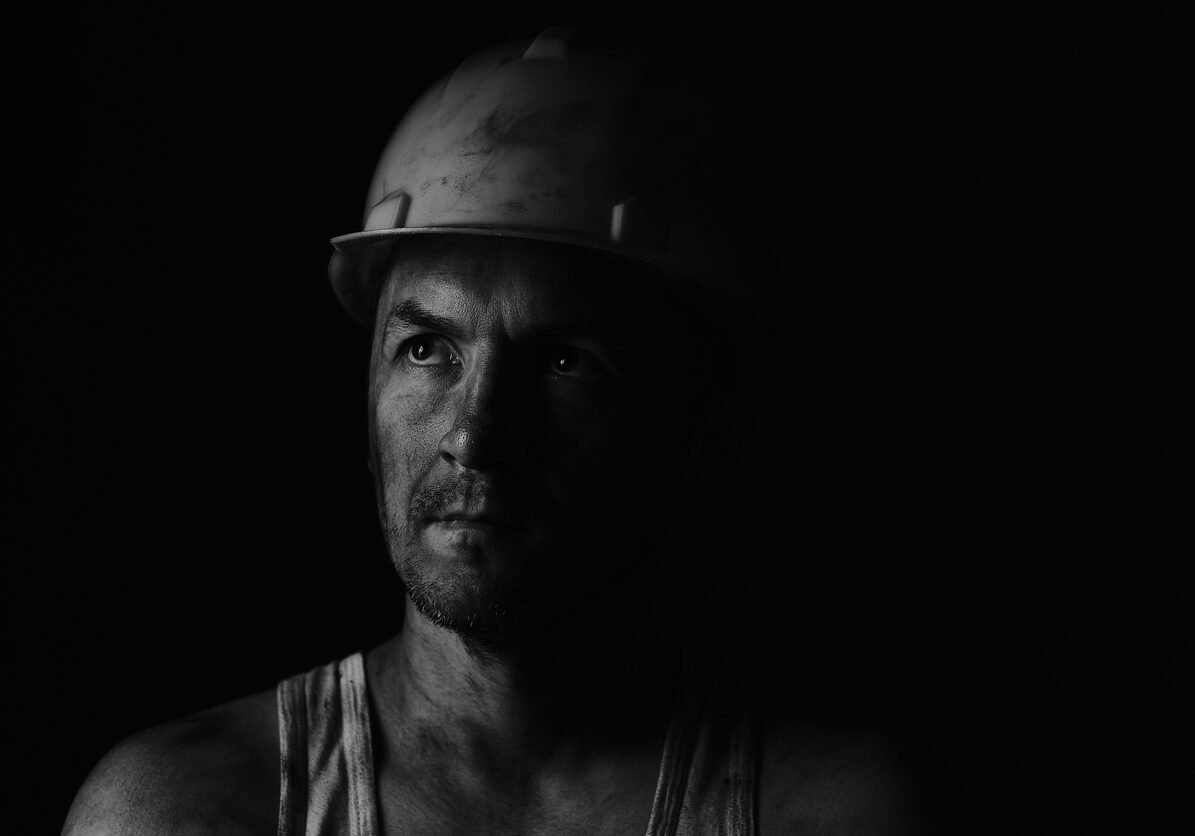
David Nixon proudly worked at the Hatfield Colliery for 20 years as a coalface worker
David Nixon proudly worked at the Hatfield Colliery for 20 years as a coalface worker. He’s begun gathering and writing short stories that capture the memories and experiences of coal miners. These are genuine personal accounts from those who toiled deep underground or laboured above the surface.
He aims to honour and preserve the quirky, sometimes perilous moments and celebrate the unique, resilient individuals who dedicated their lives to mining. He believes their experiences are irreplaceable and should echo through generations.
As with all stories in the collection of “Short Stories from the Mine,” the following event is true. Every detail has been kept just as it happened, a tribute to the men whose experiences form the heart of the colliery. This story is not a work of imagination, but a record of real people and genuine courage deep beneath the earth.

Author David Nixon
Once upon a coal mine, deep beneath the earth’s surface, where sunlight never reaches, danger is an everyday companion. Here, the most dangerous jobs didn’t always result in injury because miners had, let’s call it, a sixth sense —a consciousness gained through training from older, more experienced miners who passed on their knowledge to the younger ones. Anywhere in the mine, there are hidden dangers, so everyone needs to become aware of their working environment. They became not only aware of the environment in which they worked but also intrinsically connected to it. Though working safely was always uppermost, some miners performed feats so daring, so unimaginable, that they bordered on myth—all to keep the coalface alive and the world above moving.
Notorious B12’s unstable coalface
B12’s was the name of a coalface at our colliery. Working on this coalface meant living with a constant undercurrent of anxiety as it was notorious for roof falls. Every miner knew the signs: a faint crack overhead, a sudden shower of dust as the immense weight of the earth came crashing down. The air would thicken with tension at the slightest indication that the roof was giving way. When a fall happened, the shift’s routine was shattered. Men would gather at the edge of the collapse, cap-lamps casting long shadows over the jagged debris, as the overman and deputies assessed the danger and devised a plan.
“Men would gather at the edge of the collapse, cap-lamps casting long shadows over the jagged debris”
Those who came onto the job at the start of their shift, hearing the phrase “The face is stood, we have a roof fall,” would instantly drain the colour from a miner’s face. Sometimes, the solution was straightforward, shoring up the roof with extra props and carefully clearing rubble. At other times, what begins as a small roof hole, if not quickly remedied, would gradually become larger and then enormous. Depending on the degree of fall, it would eventually be corrected. However, at times, achieving that end would require extraordinary, daring, or courageous acts that go beyond the unbelievable.
Cavern of Hades
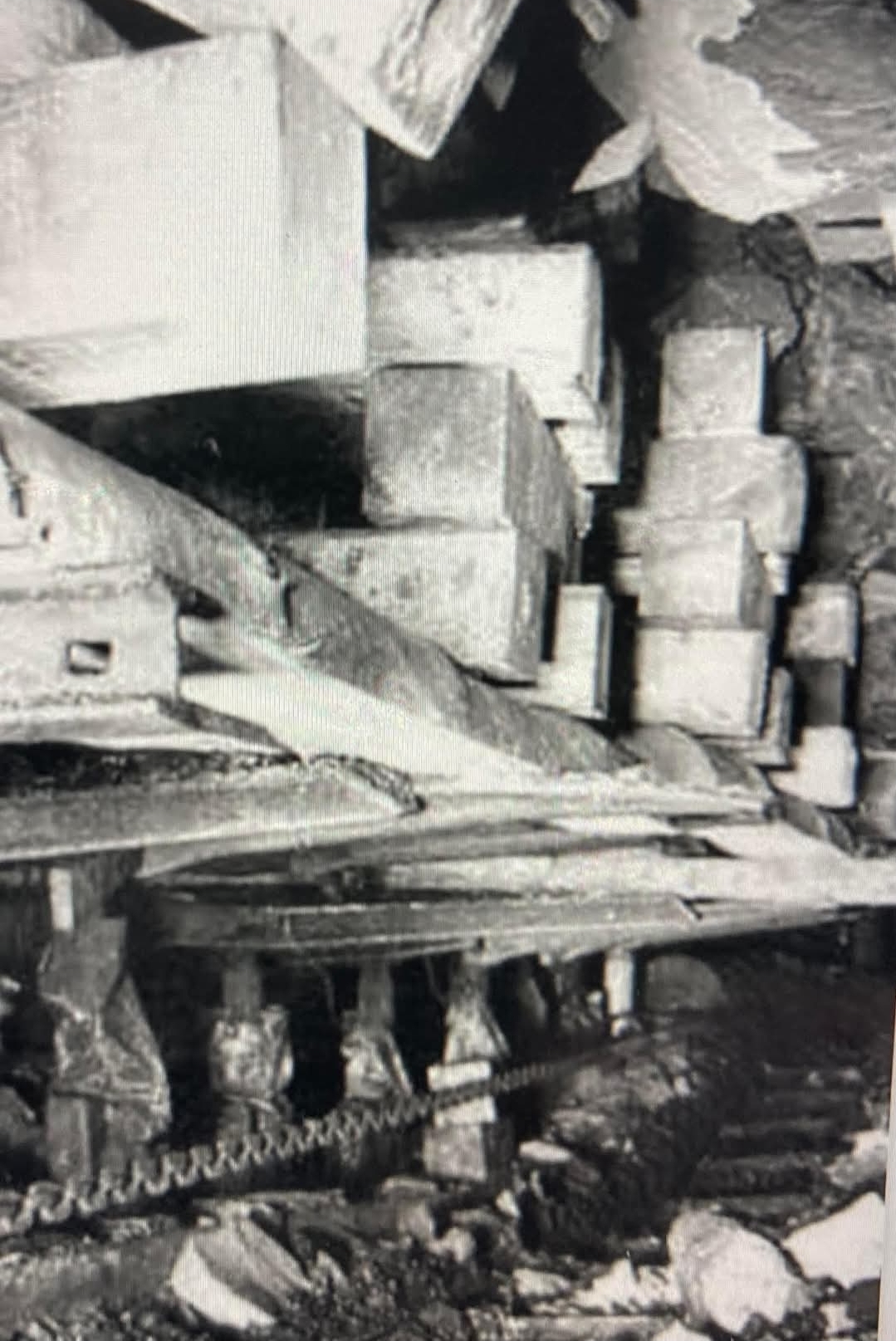
Pit supports from inside the ‘Cavern of Hades’
One hole on B12s, above the hydraulic supports, was enormous. It was likened to some mythical Cavern of Hades. The cavern spanned the width of eight hydraulic supports. At a guess, that was about 20 meters in length and 15 meters wide into the gob (the open ground behind the advancing supports after extracting the coal). This space was so high it could potentially accommodate a structure the size of a church. Monstrous breaks, as big as a car, would fall from the roof with a heavy crack onto the supports, followed by a whoosh of air along the face line. Sometimes a large lump would get trapped between the hydraulic supports, the coal face, and the panzer chain, also known as the face chain, while mountains of loose muck would rain between the hydraulic supports, filling the walking route and obstructing movement along the face line. For the rest of the coming shifts or a week, men would jigger and pick at the lumps, occasionally boring and firing to break them up. When the weight of the muck trapped the face chain, men would shovel waste into paper bags and stack them five bags high. When those areas were filled, wood was laid across the chain on wooden blocks, and more bags were placed on top. Each day, it was shovel, jigger, pick, and shovel again until the area was cleared. This was a tedious, hot, sweaty, mundane task; made lighter by interspersed banter, laughter, and lots of moaning. And, dear reader, so much moaning that if a cliff were nearby, you would run towards it. After the clearance of the downfall, the truly dangerous and crazy work would begin.
Enter the Hero
Tom was the charge hand on this shift, and as such, he volunteered to carry out the necessary task. While technically ‘volunteered,’ it was less of a heroic choice and more of others staring at Tom with a level of enthusiasm for putting themselves forward as a cat does for bath time. You can be in awe of fictitious characters like Superman, Iron Man, or the Hulk, but this guy, Tom, and others like him, rise above them all. They are the people behind the untold stories of mining heroes whose tales remain lost in the darkness of many collieries. Like Tom, their extraordinary power is their testicles of steel, as will become evident. To describe what is ahead for Tom and what he is about to face, imagine a free rock-climbing soloist who ascends without any safety equipment. This is Tom, and like the soloist, with the added uncertainty of nature.
Into Hades
After the tons of debris were removed, it was Tom’s thankless task to go above the supports, into the ‘Cavern of Hades’, to lay wooden splits (planks) above the supports in the designated area and place bags of stone dust on top. Stone dust, a type of limestone powder, is used to render coal dust incombustible, acting as a preventive measure against explosions. This process was followed by an additional layer of splits and another set of stone dust bags. The purpose of this arrangement was to cushion any subsequent falls and provide protection for workers who would later drill holes into the mining face. Six-foot rebar bolts were inserted into these holes and cemented with a compound known as Celfix. A metal box was attached to the bolts, allowing a girder to be positioned inside. The girders extended between the hydraulic supports and were held in place by props to support overhead material of more splits, enabling work at the mining face to continue and advance to more stable ground.
“it was Tom’s thankless task to go above the supports, into the ‘Cavern of Hades’”
Tom, with his heart pounding, carefully manoeuvred himself between the front of the roof supports and the coalface and positioned himself on them. Due to the tight restriction of getting above the canopy supports, Tom had to remove his belt, which secured both his lamp and his self-rescuer—a device designed for protection against carbon monoxide (CO) exposure. Dennis acted as the spotter, while other workers passed the necessary materials. What was a spotter, you may well ask? As Tom had removed his lamp and was now blinded by the darkness, the spotter’s role was to ensure Tom’s safety by providing illumination while maintaining vigilance for potential hazards, such as the dreaded falling debris.
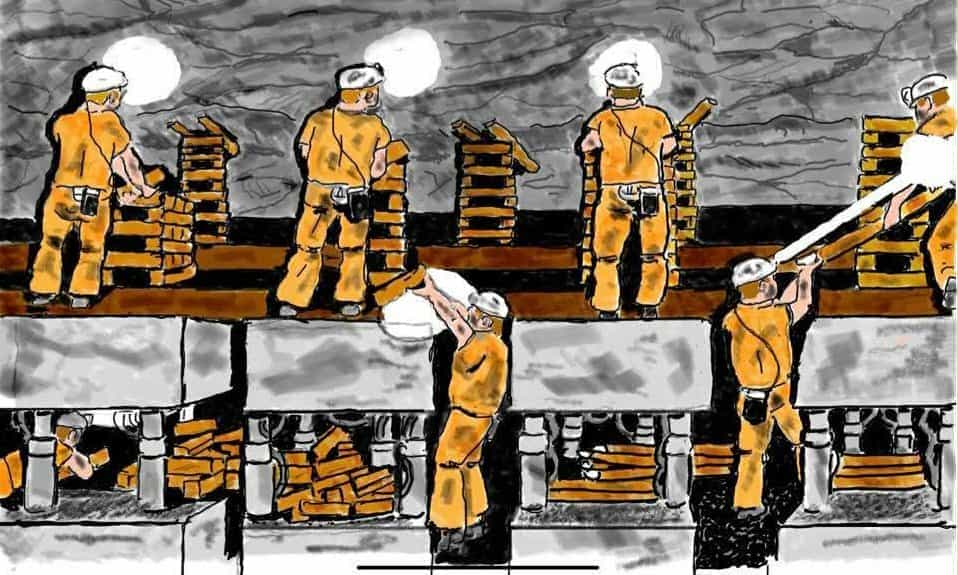
For those who don’t know, a coal mining roof fall was not instantaneous. Mother Nature, in her kindness to the miners, always provided a warning first. Fine grey dust would gently fall, a pre-warning of the monster that was about to arrive. Dennis removed his lamp from his helmet and held it in his hand, scanning it above Tom. The lamp reflected against the light grey rock and gave Tom enough light to complete his task. At the same time, Dennis’ eyes would continually dart around the cavern, watching for danger. He waited anxiously for any warning, while the burden of Tom’s safety weighed heavily on him. You can only imagine the overwhelming, mind-numbing pressure placed on him to ensure Tom’s safety.
As with all miners under such intensity, while Tom was aloft, the miners would joke, “Tom, can you see my house from there?”
“Tom, tell the missus to put the kettle on.”
“In such situations, there is only one rule: don’t look back, keep moving, and do it bloody fast.”
These comments were all made to lighten the heavy, arduous task ahead, not just for those around Tom, but also for Tom himself.
The lack of air in Hades and the heat from the gob forced Tom to remove his shirt as sweat streamed down his body like rivers, as he relentlessly continued to complete the task. Tom was determined to finish the job as quickly as possible and escape Hades without delay. Then it appeared—the dust.
Escape from Hades
The unseen, yet feared and undesired event was about to unfold. Dennis’s eyes, ever watchful, noticed the delicate, tender, but warning snowflakes softly falling. For Dennis, it’s no longer a question of if the bearer of death is approaching. Without hesitation, the devil is on its way.
“TOM! TOM! Get out,” cried Dennis. Tom instinctively knew what was happening as Dennis continued to shout the words that Tom didn’t want to hear. The grey dust, which Tom now saw for the first time, was quietly falling around him.
Everyone nearby knew what they had to do. They threw down anything they were holding and scrambled quickly along the coalface away from the fall area. In such situations, there is only one rule: don’t look back, keep moving, and do it bloody fast. Tom, faster than anyone and without hesitation, shimmied down into the gap, squeezing through the supports and scrambling towards Dennis, who had their only means of light. Both darted and stumbled along the face line faster than Usain Bolt in the 100-metre sprint. Then came the impending BOOM as the fall hit the supports, causing the face line to shudder, followed by the inevitable WHOOSH of air racing past the colliers.
All the men, trembling and gasping for breath, safely away from the fall, sat for a while listening. More rumblings and crashes continued until, after a while, the faceline fell silent. When faced with such a close call, to cope with the stress and fear, the inevitable pit jibes began, “Jack said he wasn’t frightened, but it didn’t smell like it from here.”
“You’ve got some need to talk, Greg. By the time I’d turned to run, you were already outby, opening your sandwiches.” Everyone was making light of the unspoken fear that they had just experienced.
When peace was restored and safety was guaranteed, Tom, Dennis and the other men cautiously made their way back to the fall area. Once more, they started clearing away the fallen rocks and debris. It was back to jigger, pick, shovel, filling the bags and more jigger, pick, and shovel. They would continue this until the next time Tom, or another crazy hero, would enter and undertake the thankless task in the Cavern of Hades.
NorthernLife Dec/Jan/Feb 26