



Hanging Judge Howell
by Allan Bolton
Such material, Rachel considered, would make a sensational story for the media
Rachel Simpson is deep in conflicted thought as she walks across this town centre that she didn’t know four days ago. Should she, now retired, publicise her findings, divulge her insights into the life of Judge Bernard Howell that would cause a shocked reaction? Shocked because Howell is revered here as a great man and benefactor.
What would anyone gain from spreading such devastating knowledge? And yet, Rachel has always felt undervalued amongst historians; others — no more worthy than she — have been recognised for ‘original’ research, for ‘masterful’ textbooks from which they have gained substantial income. Now, in late career or retirement, her male colleagues achieve very little, yet still indulge their competitive empty-boasting.
Society now expects to re-evaluate people from the past (inappropriately judging previous decades by the attitudes of the 2020s, some critics argue). She should be credited for her skill and persistence; she won’t gain much, if anything, financially. But it would be satisfying, well-deserved, to be granted a measure of respect that was denied during her career.
Yes, she should — she will — prepare an article. First, she’ll present a talk at the Friends of the Museum, then develop two versions — one for the media, one for an academic journal. Judge Howell attended the local grammar school in the 1700s before going to London to study law. His career flourished, and he often returned to the North, where he judged criminal cases. On retirement, he left a generous bequest to the town of his birth, including for an almshouse and for three gardens and small parks, now valued as green oases in this traffic-strangled confluence. They all still bear his name.
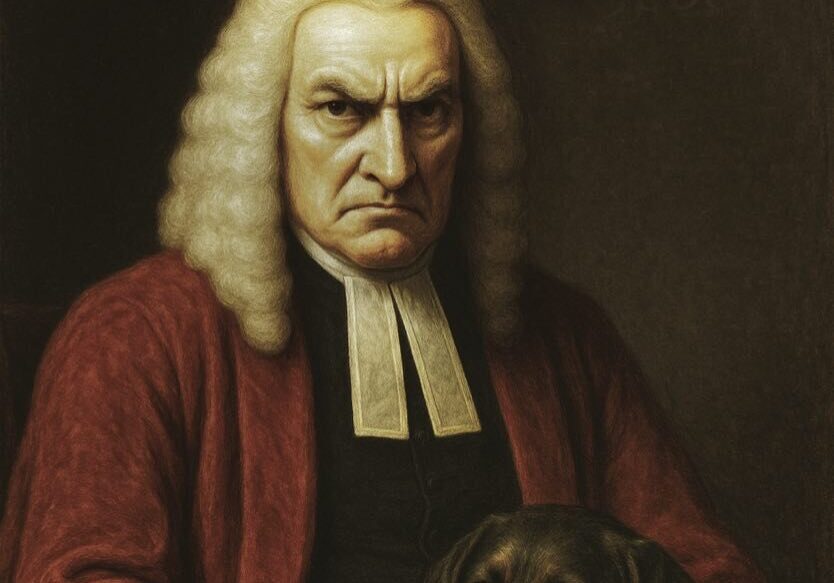
Rachel began her study by gaining access to the museum’s long-undisturbed archives. Hung above the relevant volumes was a striking portrait — Judge Howell himself in full legal regalia. It was the personal aspect which made the greatest impact: he’s seated, legs relaxed, with a dark-coated medium-sized dog sitting, head to its owner’s knee. Seeming mismatched with that part of the portrait are his chest and shoulders that look tense and rigid, a penetrating expression that sternly assesses the viewer, a mean, harsh mouth, and a prominent, hawkish nose. Looking again, she now notes that one hand is bunched in tight white knuckles clamped to the dog’s collar.
Rachel pondered, allowing the portrait to register a lasting impression. ‘How foolish,’ the cool historian in her reflected, ‘to infer anything about the man from physical features as portrayed by an obscure artist.’
When Rachel delved into Howell’s diaries, she found that he looked forward to the tours of duty which brought him back to his hometown. He would absent himself from the company of fellow judges and lawyers when the court day was done; he preferred to relax with his own thoughts. He found a quiet place on the bank of the river which flowed through the town centre. He would take a spyglass and from there survey the Easterly part of the town on the opposite bank, up to the point at the edge of the moor where criminals whom he and other judges had sentenced to death were hanged. He took satisfaction from the exercise of justice, the completion of a process of felony, trial and punishment. He was doing his duty for a society that often felt on the brink of violent disorder.
“The man was tried and sentenced to be transported forthwith to Australia for life.”
Rachel knows that this aspect of Howell’s personality was representative of the period, albeit some people would be shocked by it nowadays. Those, alongside the healthier, altruistic, insights into his character would make material for a short academic article. She’s drafting it in her mind already.
With that firm intent, she reaches an historic street as a late autumn dusk seeps from hidden alleys. A weak sun is dropping behind the buildings, below the horizon. There’s a yellowish glow from street lights along this cobbled road that leads East uphill. It reminds her of a scene from the Victorian Northern urban paintings of Atkinson Grimshaw; all that’s missing is the moon.
The buzz of home-going traffic is fading as Rachel strides the lower part of this hill, seeing few cars and fewer pedestrians. She pauses to read a plaque on the wall of the ancient Golden Lion Inn where the Pendle Witches were granted a final drink before their execution. A century and a half before her period of interest, but she’s treading the very same route. It’s happened because she recoiled from using those paid-for car parks across the road for her four days. Instead, she found street parking at the cost of a fifteen-minute walk up this hill.
One of the drawbacks of being a brisk walker is that she would find herself gaining on dog-walkers. Mostly, there’s no problem, but some dogs become nervous of being approached from behind. Those animals have an inbred instinct to protect their owner from any possibility of attack. There’s one here now. It looks like a Manchester terrier; she recalls their round tan eyebrows, eyebrows that stand out like points of light from its dark fur and from the surrounding gloom that’s settled now the street lights are all behind and below. The gap between Rachel and the dog narrows further because its progress has slowed as it turns frequently with anxious, spooked eyes. Rachel too, is uneasy, calming herself by studying her own feet, concentrating on the slow rhythm of her effortful stride.
Despite the distraction, her mind returns compulsively to the records she’s studied this week, in particular the diaries of a fellow judge. They cover two summer months when the diarist lodged close to Howell, and they allege corrupt behaviour by him. Well, they would allege if they were ever made public; it’s impossible to know whether the writer intended to expose Howell, or whether he was simply creating a private memoir, or a fiction.
He records that Howell would disturb his sleep by keeping late hours, noisily leaving and re-entering the lodgings, evidently under the influence of alcohol— brandy, he believed. With his local knowledge, Howell would strike up raucous conversations with local tradespeople, at ease with them. Rachel reflects that perhaps they included friends from his schooldays.
His neighbour noticed a young-ish couple in Howell’s company; later that only the woman appeared. Howell met her in a shaded garden to the rear of the property and, according to the diary, they would drink, chatter and engage in what Rachel might feel appropriate to describe as ‘amorous couplings’ on those summer evenings. Furthermore, the writer claimed to have discovered that the woman’s husband was charged with stealing rabbits and other game from stalls nearby. He heard that Howell had reported, or invented, the crime and advised another judge about the matter, with the result that the man was tried and sentenced to be transported forthwith to Australia for life.
Such material, Rachel considered, would make a sensational story for the media, locally at least. It could not be presented as proper historical research: claims, possibly imaginary, by one person who might have been motivated by professional or sexual jealousy. And yet, how tempting to make it public! She would be the focus of attention for once, no longer unjustly overlooked and ignored. And yet, could she justify destroying such an eminent local reputation?
While those thoughts whirl through Rachel’s mind, she’s shocked to find that she’s now close to within five paces of the dog and its master. The dog causes her much greater anxiety than is normal in these situations. The animal continues in high anxiety, yelping either to attract its owner’s attention or to scare Rachel away. The owner has shown no interest in looking behind him; he tugs at the dog’s leash to prompt it forward. Rachel now sees that the leash is no normal attachment; it’s a stout rope, the type of rope associated with hangings.
Looking around, Rachel sees that all the streets are deserted, empty of life. The dark is almost complete as she’s about to enter a wooded section at the effective boundary of the town. It’s beyond doubt that this historic lane she’s ascended is now the ancient route leading to the moor, the moor of public hangings.
The dog walker stops but doesn’t turn. Rachel stops, and the dog stops. There are now barely three paces between them. The animal’s expression has morphed from high anxiety to fierce settled hostility. Under the tan eyebrows, its eyes radiate hostility, it growls and bares its teeth. Rachel prays the owner will tug the rope again and move on. At last, the owner seems to turn. And yet no distinguishing features are clear — no face, no hair, no hands. Merely a dark, silent shape.
Too terrified to run, Rachel stands as if rooted. The dog and the shape inch towards her. Soon, the dog loses definition and seems merged with its owner. Rachel’s dominant impression is of intense cold, as if she were momentarily enveloped in a black cloud. The only sound is the snarling of the dog. She feels a sharp stab in her right ankle. On her cheek, she senses a scratch as the shape briefly enfolds her. Then the shape rolls — again like a cloud — away downhill. She can see the shape and the dog — now distinct again — turn at the first junction, and disappear. Through gasping terror, she senses something on her face. She puts up her hand and feels blood trickling down her cheek. The bite on her ankle is also bleeding.
This story is set in Lancaster. Though Judge Howell and Rachel are fictional, everything here is plausible!
To share your stories email stories@northernlifemedia.co.uk or go to northernlifemagazine.co.uk/contribute
NorthernLife Sep/Oct/Nov 25