


6 Benefits of Picture Rail Systems for Stylish Family Homes
by Northern Life
Let your home evolve as fast as your family does
Picture rail systems are tracks installed high on your wall or ceiling that let you hang art using adjustable wires and hooks, rather than hammering nails directly into the plaster. That is the short answer for anyone in a rush. They save your walls from looking like a piece of Swiss cheese, they let you move your photos around whenever the mood strikes, and they stop the endless cycle of filling and painting holes. If you own a period property in the UK or just want a cleaner look for a modern build, this system bridges the gap between protecting your investment and actually making it feel like a home.
I have spent enough time staring at crumbling plaster to know the fear. You pick up a drill, aim for a spot that seems solid, and suddenly half the wall ends up on the carpet. It is not ideal.
For a long time, I thought picture rails were just those chunky wooden things you see in your grandmother’s house. The ones covered in fifty layers of gloss paint. But things have changed. The modern versions are sleek, barely visible, and incredibly strong. They make life easier.
Zero Damage to Walls and Plasterwork

If you have ever tried to hang a heavy mirror in a Victorian terrace, you know the struggle. The brick is often like granite, or worse, you are dealing with lath and plaster that turns to dust the moment you look at it sternly.
The primary benefit here is preservation. Once you install a rail, you put the drill away. For good.
This is massive for anyone who has invested in expensive finishes. I am talking about those of us who have spent a small fortune on Farrow & Ball paint or high-end wallpaper. The last thing you want to do is puncture that pristine surface with a nail. With picture-hanging systems, UK homeowners are finding a way to keep those surfaces looking perfect. You install the rail once, usually at the very top of the wall or integrated into the cornice, and the wall surface below remains untouched.
It feels like a relief. You don’t have to worry about finding a stud or using the right rawl plug for a specific load. The rail does the heavy lifting.
I think this is particularly relevant for period home renovation projects. You spend months restoring a room, skimming walls, getting the skirting boards just right. Hammering a nail into that fresh work feels like a crime. Using a rail system respects the building’s fabric. It is a protective layer between your changing tastes and the house’s permanent structure.
If you are looking for high-quality options, you might want to check out this range of picture rail systems to see how discreet they can actually be.
Complete Creative Flexibility
Families grow. Tastes change. That print of the cow you bought at a market five years ago might not fit the vibe of your living room anymore. Or maybe you have new school photos that need to go up.
With fixed hooks or nails, moving art is a hassle. You have to take the picture down, pull the nail out, fill the hole, sand it, find the matching paint, which has probably dried up in the tin, paint over it, and then measure for the new spot. It is exhausting just thinking about it.
A rail system completely changes the dynamics.
You want to move a painting three inches to the left? You just slide the wire. You want to swap a large landscape for three smaller photos? You just add more hooks. It allows you to curate your home like a gallery. I have seen people use this for gallery wall ideas where the layout changes every few months.
With a locking hook on a rail system, the art is firmly attached.
It gives you the freedom to experiment. You can try a piece of art in five different places in five minutes without committing to any of them. It makes the process of decorating fun rather than stressful. You can browse Pinterest for layout inspiration and actually replicate what you see without ruining your walls.
There is a spontaneity to it. You might find a weird old map in a charity shop & decide to hang it up immediately. No tools required. Just hook and go.
The Ultimate Solution for Renters
Renting in the UK is tough. Landlords are often terrified of tenants damaging the property, and tenants are terrified of losing their deposits. It creates a situation in which many renters live with bare walls because they are afraid to put up a single hook.
This is where hanging art without nails becomes a serious advantage.
Some landlords are proactively installing these systems. It makes sense. It stops tenants from using those sticky strips that claim to be removable but often rip the plaster off anyway. Or worse, hammering 20 nails into a newly painted wall.
If you are a tenant, asking your landlord to install a picture rail or asking if you can install a removable one, might be an easier sell than asking to drill holes. It is an investment in the property.
I lived in a flat in London for three years with bare walls because of a strict tenancy agreement. It was depressing. A rail system would have solved that instantly. It allows you to make a space feel like yours without breaching the contract.
Enhanced Safety and Security
We need to talk about safety. It is not the most exciting topic, but it matters.
When you hang a heavy mirror on a single nail or screw in an old wall, you are trusting a small patch of plaster to hold that weight. In older homes, plaster can be unpredictable. It might hold for a year and then give way in the middle of the night.
Modern rail systems are designed to distribute weight. The rail is anchored at multiple points along the wall studs or into the masonry. This means the load is spread out.
Most systems use perlon cords (which are like thick fishing line) or steel cables. They are rated for specific weights. You can get hooks that hold 4kg or hooks that hold 20kg. For really heavy pieces, you just use two cables. It feels incredibly secure.
This is crucial if you have kids. A loose frame on a wobbly nail is a hazard. If a door slams and the wall shakes, that picture could come down. With a locking hook on a rail system, the art is firmly attached. It is not going anywhere unless you want it to.
I definitely sleep better knowing the heavy mirror above the sofa isn’t relying on a rawl plug I put in five years ago that felt a bit loose at the time.
A Polished, Architectural Aesthetic
Forget the utility for a second. Let’s talk about looks.
A rail adds a finish to a room. It draws the eye upward. In many UK homes, ceilings are decent, and a rail emphasises that. It serves a similar function to cornicing or skirting boards. It frames the space.
Modern picture rails come in all sorts of finishes. You can get primed white ones that you paint to match the wall, making them disappear. You can get brushed aluminium for an industrial look.
I have seen them used in super-modern flats where they look like a deliberate architectural shadow line. It doesn’t look like “equipment”. It looks like a design.
There is something satisfying about the cables, too. The vertical lines can add a sense of order to a room. It looks professional. It looks like you meant to do it, rather than just hammering a nail where you thought the centre was.
Effortless Installation and Adjustment
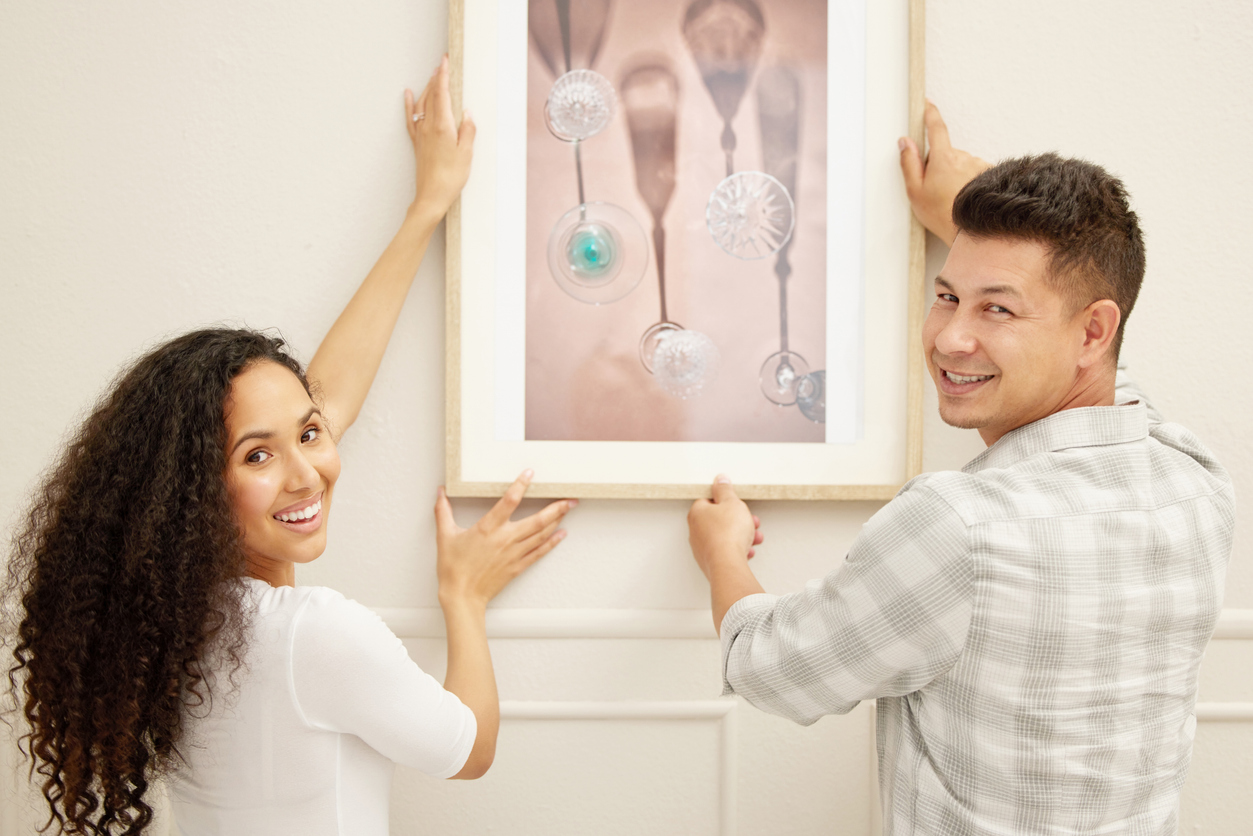
I am not a DIY expert. I can put up a shelf, but it usually takes me three times longer than it should.
The beauty of a rail is that you only have to get the level out once. You install the track. You make sure the track is straight. That is the hard work done.
After that, hanging a picture takes seconds. Literally seconds.
You clip the wire in. You slide the hook up to the height you want. You hang the frame. If it looks a bit too high, you just squeeze the hook and slide it down an inch. No re-measuring. No drilling a new hole slightly lower down and hoping the two holes don’t join up into one massive crater.
This adjustability is a game-changer for alignment. If you are trying to hang three pictures in a row, getting them perfectly level with nails is a nightmare. With a rail, you just tweak the hooks until they line up.
It makes you more willing to swap things around. You don’t dread the process. You can accommodate new art without a weekend of filling and sanding. It keeps the home feeling fresh.
Why the UK is Falling Back in Love with Rails
There was a time in the 70s and 80s when everyone ripped picture rails out. They wanted clean, boxy rooms. They stripped out the character.
Now, we are seeing a reversal. People are putting character back in. But they are doing it with a modern twist.
It seems we have realised that the Victorians were on to something. They understood that walls are for displaying things, but walls are also expensive to fix. The rail was the perfect mediator.
We are seeing huge interest in picture-hanging systems UK-wide, from London townhouses to new builds in Manchester. It is part of a wider trend of valuing flexibility. We use our homes differently now. The dining room becomes an office. The spare room becomes a nursery. The art needs to move with us.
The modern systems are distinct from the old wood mouldings, though. They are often “click systems” that let you add lights or other accessories. It is a smart home design for analogue objects.
I think it is also about clutter. We want our homes to look curated, not messy. A rail system forces a bit of discipline. It encourages you to think about placement.
Final Thoughts
It is funny how a simple piece of aluminium track can change how you feel about your walls.
I used to hesitate before buying art. I would think, “Where am I going to put it? Do I have the right wall plugs? Is it going to look weird there?” Now, I just buy it. I know I can find a spot for it in seconds.
If you are precious about your plaster or just indecisive about your decor, a picture rail system is probably the best investment you can make for your interiors. It stops the damage. It looks great. And it lets your home evolve as fast as your family does.